
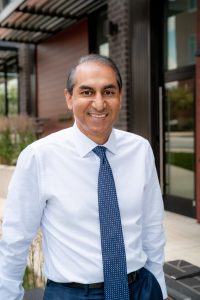
 Since graduating from UBalt Law in 1998, Faisal Siddiqui has established himself in the realm of integrity and international risk management.
Early in his career, he worked at the Export-Import Bank (EXIM), and today he serves as Global Head of Business Integrity at the World Bank Group (WBG), focusing on the WBG’s private sector projects in emerging markets.
“My primary role is to mitigate certain non-financial risks in those projects,” he says. “We’ll look at corruption risk. We’ll look at politically exposed persons, at money laundering and terrorist financing risk, and economic sanctions risk.”
In safeguarding projects from these hazards, Siddiqui also helps the WBG itself to avoid risk. “The WBG tends to have an anchoring effect, where other investors will get comfortable because we’re involved,” he says. As such, “our reputation is our chief commodity.”
All that risk mitigation comes with built-in variety in terms of the different kinds of lawyering involved. There are anti-corruption laws, economic sanctions laws, and civil and criminal codes across the globe.
There’s variety in the staff, too. “The thing I like the most about my job is the diversity of people. You walk down the hall, and everyone is from a different place,” Siddiqui says. “On my team, I have people from Kyrgyz Republic and The Gambia. The diversity of personal and professional backgrounds is the engine that keeps this place running.”
Siddiqui’s work likewise spans a broad geography. “On a given day, I could be working on a large infrastructure project in South America, and by the evening be working on a private equity fund in the Middle East,” Siddiqui says.
He’ll often visit those places in person. “I’ve been everywhere from Bogota to Manila. I’ve actually been to St. Lucia and Barbados on business — and no one believes me!” he jokes. “I made it to the beach and I swam with turtles in Barbados, but that was extra.”
Those in-person experiences make the work more real. “I like meeting the people on the ground, learning about the actual impact of our projects,” Siddiqui says. “It helps to keep me connected to all the development work that we’re doing, and I can work directly with clients to improve things, like their tax practices or their anti-corruption compliance regimes.”
From litigation to compliance
UBalt Law Prof. Mortimer (Tim) Sellers recalls Siddiqui as a student who was driven toward success. “He brought to his work intellectual curiosity, persistence, the desire to work hard and to do something good for the world,” Sellers says. “We’ve watched his career with great pride and satisfaction.”
Siddiqui came to UBalt Law uncertain about what direction he would take, “but in my last year I took the litigation clinic, and I just absolutely fell in love with it,” he says.
“The options to do litigation right after law school are not many, and I wasn’t sure a purely criminal litigation role, such as a public defender or state’s attorney, was right for me. So I chose the Air Force JAG Corps,” he says. “They just throw you in the courtroom, and you get a lot of litigation experience up front.”
He ended up doing court-martial work, as well as torts and employment law litigation. After four years of that, he went to a law firm to continue honing his skills in litigation. From there, he moved on to tackle global litigation for EXIM Bank.
It was at EXIM Bank that one of his general counsels, Howard Schweitzer, spotted his potential and encouraged him to reach for more. Siddiqui’s mentor urged him to take a promotion that would leverage the full breadth of his intellectual resources.
Siddiqui recalls being reluctant to make the leap. “I had a pretty narrow view of what I wanted to be. I loved just being the guy that everyone came to ask about litigation,” he says. But his mentor gave him the push he needed.
In hindsight, it turned out to be exactly the right decision. “That was a critical decision, because ever since then I’ve had managerial roles, up to leading a group of 50 people,” Siddiqui says. “That would never have happened had I not had that key mentorship from Howard.”