TCAP Middle School (MS) Model Description
In 2005, CFCC launched what is now called the Tackling Chronic Absenteeism Project (TCAP) (formerly the Truancy Court Program, or TCP) to reduce chronic absenteeism among Baltimore area students. The program focuses on voluntary involvement of students and families and utilizes non-punitive, holistic, and data-driven interventions that work to identify and address the root causes of chronic absenteeism for each child. TCAP seeks to improve school attendance, while building a foundation for long-term success not only in academics but also in life, more broadly. Missing school increases a student’s likelihood of getting suspended, dropping out of school, and using substances and these outcomes increase a student’s risk for juvenile legal system involvement. Through its work, TCAP helps to interrupt the school-to-prison pipeline (STPP) for vulnerable youth in Baltimore.
The program is currently wrapping up the second year of the new Middle School (MS) model for traditional TCAP students. The MS model serves students and their families from sixth grade through eighth grade in three Baltimore City Public School (BCPS) schools, preparing them for the school choice process, creating individualized plans for post-secondary success, and equipping them to be community leaders and peer mentors.
While the original TCP worked with students in grades 3 – 12, the new MS model relies on almost 20 years of data to pivot to a three-year model that focuses only on middle school-age students. Over the decades, regardless of the name, the program has had the greatest impact for students who have some control over their ability to get to and succeed in school. For most students, this shift to more freedom occurs around the sixth grade – during the transitionary period between childhood and full teenager. The weekly TCAP model, group restorative practice circles and individual check-ins, is also very well received by middle school students.
Each grade has a curriculum that builds upon the previous year, detailed below:
Grade 6: Building Confidence through Foundational Skills
Students are selected for TCAP based on their fifth-grade attendance rate, grades, and sense of belonging at the school. Throughout the year, students work through the TCAP curriculum through a series of restorative practice circles, workshops, and discussions on the following topics – Academic Success, Building Healthy Relationships, Civic Engagement, and Financial Literacy. Students build comradery through weekly restorative practice circles and check-ins with volunteer legal mentors.
The final TCAP meeting of the sixth-grade cohort is the TCAP “graduation” – where sixth grade students are awarded tokens to spend at the TCAP Store (stocked almost exclusively by the one and only 5Below). Tokens are awarded based on grades, attendance, and when students reach their individually set goals. Parents, caregivers, and all other TCAP participants are also invited to celebrate the newest cohorts’ accomplishments.
Grade 7: Fostering Cooperation through Communication
Students who choose to continue with the program continue to receive academic support, with bi-monthly check-ins and focus on the following curriculum – Understanding Baltimore City’s High School Choice, Building Blocks of Conflict Resolution, and Community Violence Prevention through Healthy Relationships. During the spring session, seventh grade students work together to develop a panel discussion on how to foster healthy communities, which they present to the sixth grade TCAP students at the penultimate TCAP meeting of the school year.
Grade 8: Building Community
Looking forward to TCAP’s first eighth-grade cohort, students continuing in the program will learn how the skills to serve as mentors to incoming TCAP sixth-grade students – focusing on forming supportive pairings. Through this program, eighth graders draw on their own experiences to guide younger students in areas such as healthy relationships, academic success, and community safety. Once matches are established, mentors will be encouraged to use journaling to reflect on and track their efforts.
As the program progresses, the TCAP team transitions eighth grade students to collaborate with seventh graders to prepare for student panels, where both groups respond to questions from incoming sixth grade cohorts and selected peers identified by school liaisons.
The MS Model So Far
In the 2025-2026 school year (SY26), TCAP’s MS model is serving 76 sixth and seventh graders from Booker T. Washington Middle (BTW), Katherine Johnson Global Academy (KJGA), and Maree G. Farring Elementary/Middle (MFG). In the last year and a half, TCAP has:
- Conducted a total of 6,622 outreaches (phone calls, emails, and text messages) to TCAP students, parents, and caregivers
- Distributed a total of 2,063 resources and referrals to families
- Conducted 452 home visits to support schools with attendance concerns and families with requested resources and referrals
- Distributed 255 bags of groceries to Baltimore City school students and their families
- Held 237 restorative practice circles with TCAP students
- Distributed 168 legal referrals and resources to Maryland families
- Coordinated and hosted 67 tutoring sessions to support individual student needs.
The TCAP Team continues to work closely with community partners to facilitate both in-house and guest workshops and experiences. The MS model has been able to partner with the following experts, in their respective fields, to provide TCAP students with meaningful and informative experiences. TCAP students have participated in the following workshops over the almost two years:
- “‘Cut the Silence’ Barbershop Collaboration”: In close collaboration with the Mayor’s Office of Neighborhood Safety and Engagement (MONSE) and the Gud Barbershop, TCAP students were able to receive free haircuts and dinner while MONSE and TCAP staff facilitated a conversation about domestic violence and safety in relationships between barbershop staff and the students.
- “Celebrating Herstory Month Salon Event”: Inspired by the “Cut the Silence” MONSE Event, staff at Booker T. Washington Middle School partnered with the Community Giveback Program, TCAP, and MONSE to create a similar experience for another group of TCAP students. This unique opportunity is aimed at young female scholars to gain valuable insights, build confidence, and connect with peers and mentors in a supportive environment. The Community Giveback Program allows educational partners to invest in the community they serve while demonstrating their commitment to the well-being and development of young women. Students visited a salon and had their hair washed and styled by one of five hair stylists, each of whom owned their own salons. Students also received breakfast and a swag bag with self-care products. During the event, students discussed red/green flags in relationships and asked the stylists about their career pathways.
- “Understanding Consent”: This workshop, facilitated by staff at MONSE, introduced to sixth graders, and reviewed with seventh graders, positive and toxic traits in relationships. Students identified their own “red” and “green” flags, sharing personal experiences and reflections with the group. Students then participated in an activity and discussion about consent and personal choices.
- “Cupcake Communications”: This workshop, facilitated by Baltimore B.R.A.T.Z., is an interactive Social Emotional Learning (SEL) experience designed to teach students how clear communication, teamwork, and listening skills help achieve shared goals. Through a hands-on activity, students learn how miscommunication can impact outcomes and how intentional communication strategies strengthen friendships, relationships, and collaborative environments. This workshop aligns trauma-informed practices and supports students in developing social awareness, relationship skills, and responsible decision making.
- “Academic Success”:
-
- Grade 6: review of the academic calendar; tips on how to talk to teachers; open floor discussion of “career paths” of each TCAP team member.
- Grade 7: overview of high school choice; detailed breakdown of application types and important categories; detailed breakdown of various Baltimore City high schools and specialty programs.
-
- “Global Gardens”: High school students from Baltimore’s Polytechnic High School presented a workshop on climate change and how to address it, to TCAP students at Katherine Johnson Global Academy. Following the presentation, students were given the opportunity to plant their own herbs and vegetables. By early January the students will harvest their plants and potentially re-plant!
- “Understanding Stress & Practicing Mindfulness”: CFCC’s Executive Director presented a workshop identifying how stress affects the body both physically and mentally and followed up with a series of breathing and mindfulness techniques that students could use in their daily lives.
- “Building Healthy Relationships”: This workshop, facilitated by MONSE, engaged TCAP students in a conversation around identifying healthy and unhealthy signs in their relationships with family, friends, mentors, etc. Students were given small business cards with key words identifying positive versus toxic relationships to keep and review. Materials from the presentation were shared with parents via email.
- “Introduction to Voting”: CFCC’s 2024 Student Fellow presented this interactive workshop was presented to sixth grade TCAP students. Students learned about the history of voting, different political parties, and were introduced to current state and national politicians. After the lesson, students were encouraged to share what their political platform would be, if they ran for their school government.
MS Model Impact
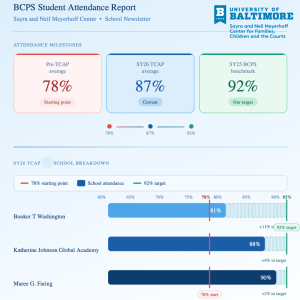
Although TCAP meetings are only held once a week at each school, it is not uncommon to see the TCAP team in the school buildings throughout the week. Since the program model has shifted away from the annual application process, remaining in the same schools has allowed the TCAP team to strengthen relationships with school staff and teachers exponentially. This allows not only smoother communication throughout the year but also allows the TCAP team to develop a better understanding of the school climate and culture. Remaining in the same schools has also had an unintentional impact – inspiring a mini-TCAP for fourth and fifth grade students! MGF school staff, inspired by the weekly check-in and problem-solving focus of the program – worked together to run an in-house version of TCAP. So far, MGF staff report that the program has already improved students’ attendance and attitude towards school.
At another school, one of the new sixth grade cohorts is largely made up of transfer students, who are new to the school. Although these all students struggled with attendance at their prior school placements, transferring school solved the largest attendance obstacle (transportation). This roster was purposefully created with the intention of fostering a sense of community and stalling any potential attendance issues before they occur, especially as the school struggles with increasing violence within its halls.
During the September orientation, the TCAP Team first met Student A, a student who naturally fostered camaraderie among her peers but had already developed a reputation for insubordination with school staff. By the end of the second TCAP session, the Team recognized that Student A was highly intelligent, articulate, and naturally charismatic, particularly in her storytelling. She was open and reflective in sharing with both the Team and her peers about her ongoing challenges with respecting certain staff members and students.
Through regular check-ins with the volunteer Legal Mentor and law clerk, Student A was encouraged to pause and reflect on her emotional responses, especially her tendency toward verbal outbursts. These conversations helped her identify emotional triggers and develop greater self-awareness. With the support of the Team, Student A practiced mindfulness-based strategies focused on responding thoughtfully rather than reacting impulsively.
As part of this process, Student A learned grounding and breathing techniques to help regulate her emotions during moments of frustration. These practices allowed her to slow down, create space between her emotions and actions, and choose more respectful forms of communication. Additionally, her Legal Mentor guided her to reflect on the potential long-term consequences of continued disrespectful behavior, strengthening her understanding of how her choices could impact her academic progress, relationships, and future opportunities.
By November, Student A was consistently applying these mindfulness strategies and began to see meaningful improvements in her interactions. She reported feeling more in control during conflicts and demonstrated an increased ability to de-escalate situations. While she continues to experience occasional conflicts with peers outside of school, these moments are addressed through restorative practice circles and ongoing check-ins. Student A is becoming more reflective about her motivations and intentions during conflicts and more aware of their long-term consequences. As a result, her relationships with teachers and school administrators have improved, classroom removals have decreased, and her sense of connection with peers has strengthened. She has also experienced improved academic outcomes, reinforcing the positive impact of her growing self-awareness, emotional regulation, and respectful communication.
The entire TCAP Team is excited to continue working with Student A, especially throughout the new three-year model over the next two years.
Coming Up!
The TCAP Team is excited to continue collaborating with TCAP parents and caregivers on an official TCAP Parent Advisory Board (PAB). The PAB will have up to five spots and will open to all TCAP parents and caregivers.
Board members will be asked to commit to attending at least 2 meetings throughout the school year, be available to provide their perspective on program curriculum, and advise the TCAP Team on barriers to attendance that are relevant to their communities. In response to recommendations from the PAB, TCAP will also gather and report student feedback on workshops through post-session surveys to ensure timely and accurate insights into student engagement.
The TCAP Team will use the school’s summer break to review and improve program curriculum, with community input, and continue following up with the current cohort of students.