
By embracing their entrepreneurial spirits,
these grads built businesses that redefined their markets
STORY BY ADAM STONE

A strong entrepreneurial spirit is common among University of Baltimore students. Nurturing that spirit has long been a hallmark of a UBalt education. And for some, that was what laid the groundwork for their success in business.
Custom chicken coops, destination weddings, contracting and construction. Even a high-end watch brand with your name on the face. While their industries may vary wildly, some things are constant for these alumni: hard work, dedication and a true passion for the task at hand.
A BUSINESS FOR THE BIRDS
After Kathy Vegh, MBA ’01, graduated from UBalt’s business program, she took over her family’s high-end home furnishings business in Ohio. For most of the two decades she spent growing the family business, she worked long hours and 7 days a week.
To help ease herself out of constant work mode, Vegh decided instead to raise chickens. Her husband surprised her with a coop at Christmas. Three chicks soon followed in honor of their daughter’s third birthday. “I really wanted something that would connect my family with nature,” she said. The poultry soon became pets, and she decided to upgrade their living arrangements.
When she found options for customization lacking, she decided to work with a local Amish builder to enhance and expand their habitat. “I was just going to share my experience of the benefits of chicken keeping—the mental health enhancements, physical benefits like blood pressure regulation and simply slowing down,” she said. “But then the businessperson in me took over.”
“I feel a deep sense of obligation to show her what it is to be a woman in today’s world and to be an entrepreneur.”
KATHY VEGH, MBA ’01
In 2019, her business Cutest Coops was born. There were no significant online competitors with a focus on luxury coops, and “within those first 12 months, we sold to 26 different states. We had a ton of crazy traction,” she said.
Vegh recently doubled down on that success, opening another business that caters to women’s need for private spaces: SheSheSheds sells customizable sheds with shutters, window boxes and other feminine touches.
It’s a complete 180 from what she did in the family business. “I spent 20 years of my life focused on luxury man caves. So it’s quite funny how the pendulum has swung,” she said. All this speaks to how she parents her now 13-year-old daughter. “I feel a deep sense of obligation to show her what it is to be a woman in today’s world and to be an entrepreneur.”
Vegh started out in UBalt’s School of Law, and the business school responded positively when she asked to pivot. “They allowed me to be their first entrepreneur major,” she said. Her education “highlighted what I was good at, what I wasn’t, and how I could build a business with complimentary skillsets from others.”
And that ain’t chicken feed.
WATCH CLOSELY
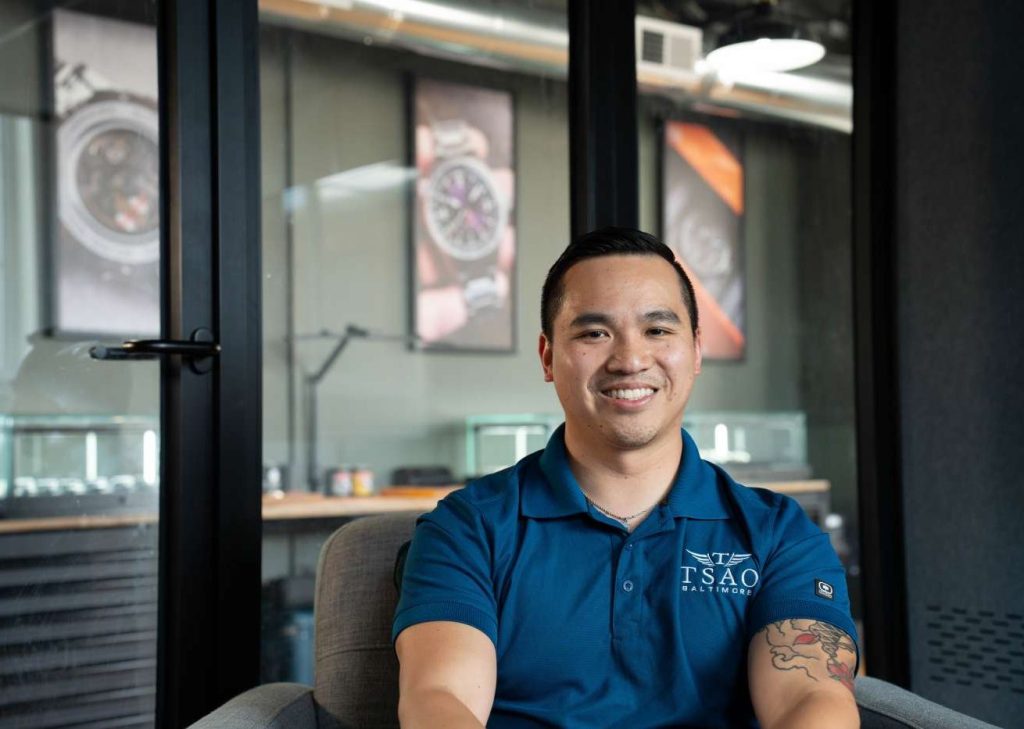
Yes, some people still wear watches. Alan Tsao, B.S. ’11, MBA ’21, does, and he loves them. He got his first watch at age 10 and became a little obsessed. “The most valuable thing that anyone has is time, and every single part in a watch has a role in telling time. It’s pretty cool,” he said.
By 2017, he’d collected about 35 timepieces and found there weren’t enough options in his price range to scratch his itch. So he sold off most of that collection and used the money to launch his own Baltimore-themed luxury watch company, Tsao Baltimore.
“We generally work with several different manufacturers around the world, from Switzerland, Japan, Germany, Hong Kong,” he said. “I used to do the assembly work for the watches, and then we contracted it out to a company in Hagerstown. Earlier this year we actually acquired that company in Hagerstown, and we brought everything to Baltimore.”

Charm City factors big in this story. “A watch should have a story,” he said. “There was nothing really ‘Maryland’ in watches. There was nothing that spoke to me and what I believed in, so I wanted to create that.”
He looked especially for Baltimore-themed watches in the $350 to $1,500 range but didn’t find them. He saw an opportunity and stepped in. Tsao’s timepieces now have faces that honor the Key Bridge, Natty Boh and the Orioles. By 2024, the company had topped $1.5 million in sales and it’s growing every year. Last year, Tsao moved from a 750-square-foot space to a 7,100-square-foot facility.
UBalt played a key role in all this. “It really helped shape me, with a lot of hands-on experience. It helped me figure out how to become a better professional and how to apply that in the real world,” he said.
NUPTIAL BLISS
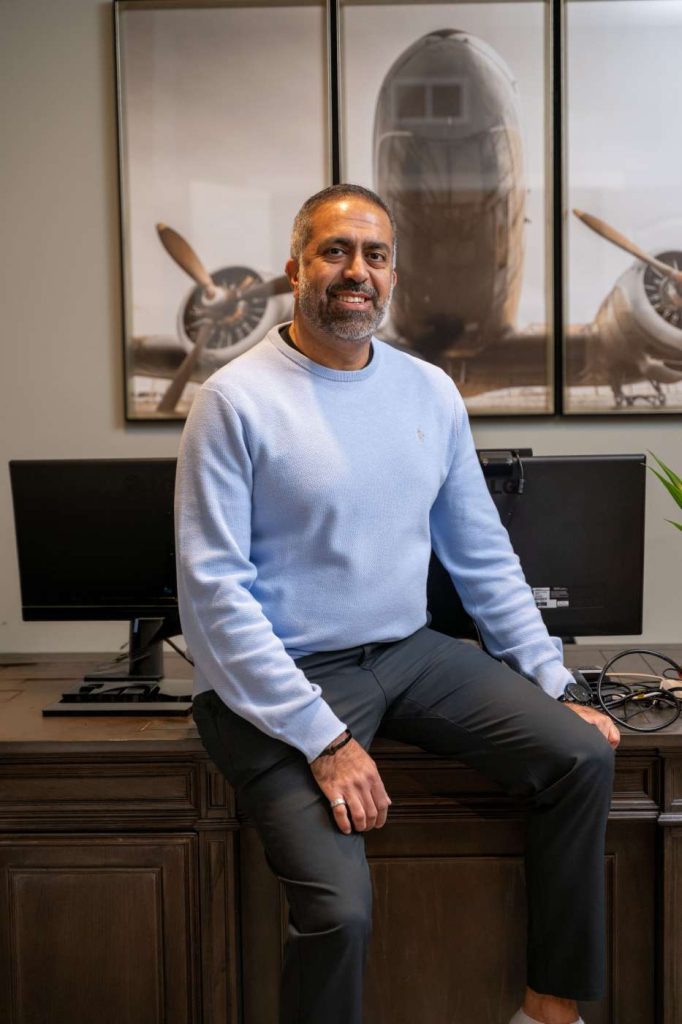
Ateet Ahuja, MBA ’09, loves weddings. He founded Planet DJ Productions in 1996, in part to provide music for South Asian themed marriage celebrations. In 2015, he expanded, launching Indian Destination Wedding.
“I had already gained the trust of my current brides and grooms, and I wanted to start selling honeymoons. I quickly realized there was a gap in the industry: nobody was focusing on South Asian destination weddings,” he said.
To be clear, these aren’t weddings in India. These are Indian Americans looking to host full-on, Indian-style destination weddings in Mexico and the Caribbean. That’s no small feat. “The parents who are paying for it want an authentic experience: the food, the henna artist, the music, the décor,” Ahuja said.
These are big-money affairs, at $250,000 and up. Expectations are high, and South Asian weddings can be complex. “India alone has over 200 dialects, and each state has its own food, its own way of dressing, its own culture,” he said.
It helps that Ahuja, being Indian, speaks Hindi, Punjabi, Urdu, and even Spanish. It helps, too, that he already has a solid background in these kinds of events. “I took my knowledge of Indian weddings from Planet DJ and used it to create this,” he said. “It really helped propel me.”
Ahuja’s MBA from the University of Baltimore education set him up for success. He specialized in international business and learned a lot about contracts—an area of importance in his business. A class in global marketing “was one of the most pivotal classes I ever took,” he said. “I’m decent at running a business but learning how to market myself was really important.”
Ahuja has maintained ties with the school and even established a scholarship in memory of his brother Ajit, also a UBalt graduate, who passed away at a young age. “I want to help young entrepreneurs,” he said. “If you can make someone else’s life a little easier, why not do it?”

BUILD UP
After Ted Goloboski, B.S. ’75, finished college, he went to work in public accounting. Briefly. “After one week of doing that, I knew it was not going to be my thing,” he said. He’d done some construction work previously, so he got a job pouring concrete. But that was only the beginning.
“It wasn’t that complicated from a business perspective, and I wanted to do it myself,” Goloboski said. “I always thought that I could do better than just being a wage earner. Some people saw it as a risk, but I saw it as an opportunity—because I could control all the variables.”
He started a business with a friend (not always the best idea). When that fizzled out, Goloboski launched Baltimore-based Belfast Valley Contractors, Inc. Since 1983, the company has poured concrete, mostly vertically: They help build condos, hotels, hospitals. “If you see a building in a city with a crane on top, that’s what we do,” he said.
Concrete is a tough business— literally. Plus, it’s hard to get good help, and there’s lots of competition. Once you get beyond the startup phase (“All you need is a pickup truck, a two-by-four and a good work ethic,” he said), it starts to get capital intensive. Cash flow is always a concern. But Goloboski’s business grounding from UBalt helped him navigate these challenges successfully.
“All you need is a pickup truck, a two-by-four and a good work ethic.”
TED GOLOBOSKI, B.S. ’75
“It gave me the real-world mentality of cost accounting and tax accounting, as well as the much broader perspective—the economic side of how money works, supply and demand, and so on,” he said. “With the combination of those skills, I had a leg up.”
Goloboski has always kept the University in mind: he recently donated the labor and materials to create a concrete patio to display a massive honeybee sculpture, a donation from another alumnus, Sam Rose, LL.B. ’62. It’s just one of the ways that Goloboski gives back to the community.
He described himself as a firm believer in education, food and housing. His company supports various groups, including Loyola Blakefield High School, the Maryland Food Bank and Helping Up Mission. If others would do the same, Goloboski said, “the world would be a much better place for everyone.”