
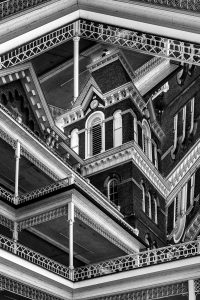
Building Insanity by John Zywar
The Company
Tayler Elise
I unload the dishwasher for the fourth time today; the water leaves my hands dry and cracked. I check on the office spaces, restock the pens and sticky notes, straighten out scattered desk chairs, wipe down dry erase boards. It is all about presentation, the manager told me on my first day at The Company. It is about making sure the space looks pristine. She straightened the sticky notes then straightened them again.
The manager recommends I sit at the front desk, watch the security log as members scan in and out. It’s like a cheat sheet, she said, when a member swipes their card to come in, the log updates here, and you can see their name. We are expected to greet members by their first names each time we see them. Each member is to have a personalized experience. Hi Linda, I say to a woman I’ve never met, with a smile wider than feels natural. She grins, her smile not quite reaching her eyes, pretending to recognize me. She breaks eye contact by rummaging through her Kate Spade bag.
The Company at its core is an adult daycare; we talk members through their bad days, we clean up their messes, we build charcuterie boards for snack time. We do not rinse the vegetables. We cut around mold. We must immediately send pictures of the boards to The Company’s #foodandbeverage Slack channel to encourage creative presentation across all locations. The Company has offices globally. Some locations have showers, full kitchens, gyms. Others never let you leave.
We have kombucha and cold brew on tap; they are always running low. Charlie wears zipped-up jackets and gym shorts each day, rents out office space for his CBD business. He gave me free samples on my first day, told me he smoked with the previous manager after she quit. One night I took three times the recommended amount of CBD sleep gummies. They didn’t help me sleep but they tasted like mangoes and made me dream about God.
Besides Charlie and a few real estate agents, everyone works in AI. They are all working to bridge the gap between AI and humans, to dissolve the distinction between the two. I ask Noah, who is covered in American traditional tattoos and carries a canvas tote bag, if he worries human-presenting AI models will replace human connection. He tilts his head and tells me his work is an inevitability. It catches me off guard. His certainty feels prophetic, something out of Revelation. When I fail to stutter out a response, he offers me his business card so I can look more into his work, reach out with questions if I’d like.
Strangers come in for free trials; they swipe their badges on every door just to see where they can get in. We revoke access to members when they are laid off. It feels like we are in a fortress, lifting the draw bridge. Spencer works in something called ethical AI management. I tell him I have never heard of his line of work; he tells me it is made up. The thing about Spencer is that it is never clear if he is joking, so I can only offer small smiles of faux understanding. He comes to the front desk after his meetings when he is restless and wants to talk. He is a remote worker and middle-aged and married. He rents out space just to have people to talk to. I sense it in the way he lingers for just a moment too long after a conversation fizzles, as if he’s trying to reignite a spark.
He asks if dating in our twenties is still worse than he remembers and if we thought the thing that happened in the news was fucked up too. We agree, though we avoid going into detail about how we feel. I am reminded of the cameras in the common areas, and I feel The Company listening. Spencer says he has an internet wife he plays online poker with. His real wife wants him to wear a helmet when he rides a Lime scooter to the office. I step away to unload the dishwasher again, and when I return, he is telling the manager he is a skeptic but spiritual, says that coincidence can feel like too easy of an explanation. The manager says she understands, but then her eyes flicker to her Apple watch, and she says she has somewhere to be. Spencer and I linger in silence for a moment. I want to tell him I have religious OCD, and that I reach for coincidences all the time. Coincidence gives the world order, meaning, rules. Even as an Atheist, it turns God into a river, something to drown in. During training, the manager said to be careful with boundaries; it can be easy to overshare here, she said, the members can get chatty, but remember, this is a professional environment.
I disappear into the wellness room for my hour-long, unpaid lunch break. The room is soundproofed for telehealth appointments, has a mini fridge for breastfeeding mothers. My lunch break is when I schedule bi-weekly sessions with my therapist who is young and doesn’t take insurance but operates on a sliding scale. I tell her about all of the women I am scared of becoming. As she responds, the mini fridge kicks on, a deafening white noise, and I do not hear what she says.
After I toss the plastic remains of my Trader Joe’s salad, I go on rounds, which involves restocking the amenities in the offices and bathrooms. I restock the eternally depleting pens and sticky note holders. In the bathroom, I refill the single-use deodorant tray and mouthwash in expensive-looking glass bottles. The bathrooms are all gender neutral because The Company preaches inclusivity. In May, we served pocky and mochi to celebrate AAPI month. In June, we had Pride-themed happy hours, decorated the bar with rainbows, and served queer-branded wine. At The Company, representation is something to be devoured. It is one of the last safe spaces left; it costs $400 a month to use the common areas, fill up on cold brew. Even more for a private office. Members who don’t pay for private offices take calls in the common areas. I hear snippets of their conversations, a glance into their lives which feel entirely different from my own. They’ve very Whole Foods; they’re very Erewhon; they’re very equitable, says a new member, speaking loudly. His brown hair is graying and he is always wearing AirPods. Contemporary jazz and Tame Impala play in the bathrooms loudly, quietly in the lounge. The playlists are determined by corporate; we cannot pick or skip songs.
I take note of the rooms without cameras. I cry in the bathroom over someone who does not love me anymore, someone who does not know I spend my days plating varieties of goat cheese, artfully surrounding them with crackers and vegetables. I cry in the wellness room. I cry in the storage closet with crates of La Croix and Dr. Pepper. When I leave, my eyes are still red and damp. The members pretend not to notice. For the first time in years, I begin to pray compulsively, repeating hail Marys in my head. Only in the rooms with cameras, as if they can hear. The prayers turn into a constant static, a shield. If I call out for God, I can pretend to have an ounce of control. As I scrape oatmeal off half a dozen bowls in the sink, I know God isn’t listening. I consider going to a psychic, just to be given an answer, a shortcut.
I laugh in the food and beverage closet with the manager. She asks me who I have been seeing recently, because loneliness is the only thing we have in common, and she asks whatever happened to the sperm donor. I tell her he had too much pent-up theater kid energy he didn’t get to express in high school, and now he takes it out on the rest of us by talking and singing loudly in bars. For a moment I worry I’ve lost my gentleness so I add, he will make some other bisexual girl with nose piercings very happy one day. Then she asks about the farmers market vendor or the girl who brought me flowers on the first date. I tell her they never quite work out. She texts me a pre-drafted break up text she wrote using ChatGPT. It read as professional and polite and cold; Hey! I do want to be honest. I’ve really enjoyed getting to know you, but I don’t see it going much further than where we are now. I joke that sending me this text is a bad look; I should report it to HR. She rolls her eyes and says she sends it to men who get attached too quickly. It makes her feel lighter; she warns me there is bad karma in ghosting. I do it anyway.
We muddle berries for the weekly happy hour. Set out the raspberry mojitos with the required non-alcoholic ginger beers. The Company encourages us to drink with members, learn about their interests. We are to take notes on their likes and dislikes, log them into the portal so we can order their favorite wings to celebrate promotions or express condolences when they lose a loved one. At the end of each quarter, the team that has collected the most facts wins a free day off.
Slightly tipsy, I restock the drink fridge because the members will riot if we run out of soda, oat milk, and half and half. I forget to restock the snack fridge with hard boiled eggs from Costco until someone complains. I steal black unbranded pens because the ink comes out smooth, and it feels like it could make me a better writer, like I could find a purpose. We are not allowed to serve ourselves breakfast, snacks, drinks, until thirty minutes after it has been set up. We must give the members time to load up on cream cheese, cured meat, unwashed vegetables. When the snack time rush dissolves, I pick at the charcuterie boards when they are nearly empty because I have not been eating like I should. Their scraps keep me alive.
Tayler Elise (she/her) is a writer and communications professional. She is a Seattle transplant originally from Richmond, VA. She once spent a month working at a coworking space and enjoyed it more than this piece would lead you to believe. When she’s not writing, she spends her time reading, crocheting, practicing yoga, and going on long walks. Learn more about her work here: taylerebutters.wordpress.com.
John Zywar’s current project is to interpret the intricate architectural designs at The Ridges, a repurposed insane asylum in Athens Ohio. The Ridges now houses an art museum at Ohio University. His link with the old building stems from his two summers working at a similar institution as an impressionable teenager. His writing and artwork surrounding The Ridges have been published by So It Goes. the University of Akron’s literary magazine, and Dipity Literary. Heavy post processing of these architectural features are a current obsession. Other non-insanity related photos have appeared in Massachusetts Audubon and in various literary/art publications including Burningword Literary Journal, The Poetry Society of New Hampshire’s Touchstone, The Closed Eye Open, 3Elements Review, Stonecrop Magazine, Wild Roof Journal, Beyond Words, Fusion Art, and Light Space & Time Online Gallery.