
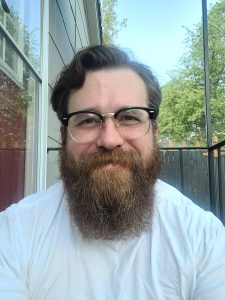
Poet John Sweeney
Kim Wernsing & Shahrzad Taavoni recently sat down for a Q&A with poet and Welter contributor John Sweeney.
What got you into writing poetry and how does it make you feel to write?
I took a creative writing class in my second year of undergraduate studies. I fell in love immediately. Like most young poets I was infatuated with the idea of breaking language and the agency that provided. By the end of that semester, I had changed my major to English with a minor in creative writing
The feeling is exhilaration. It’s like solving a puzzle, assembling this unique combination of words that has always existed in some ethereal sense, but no one ever thought to put them together. It’s the thrill of discovery.
Do you have any other ways of creative expression?
I am also a singer-songwriter. I perform under the stage name Jasper Juniper, and I’ve recorded a few albums under that name since 2013. I have a little home studio I set up, and it’s so much fun to record and play around with noise. Sound is a language all its own.
How often do you write?
I try to do a little bit every day, even if it is just a quick journalling. I love to sit around for hours and write, but that is just not feasible most days. When in doubt, I always carry a small notebook on me, in which I like to write interesting words or turns of phrase I hear or read throughout the day. In that way, I like to think I am always writing.
What happens to you psychologically when you don’t write frequently?
Oh boy…I spiral! It’s by no means a healthy disposition, but it is so hard to feel like a writer when you’re not writing. I think Auden put it best when he wrote, “In the eyes of others a man is a poet if he has written one good poem. In his own he is only a poet at the moment when he is making his last revision to a new poem. The moment, before, he was still only a potential poet; the moment after, he is a man who has ceased to write poetry, perhaps forever.”
This poem was more down to the bones because of the flash theme of our journal. You chose to use less words than what you normally write in your poems. What was that like?
It was a challenge. Every word that is present needs to do so much more work. That’s why I think Japanese forms like the tanka are so valuable. The fixed syllables force you to examine your diction thoroughly. Art starts to become something of a science in those examinations. The poet is forced to understand each word with an intimacy that is not normally demanded.
What inspires your poetry? Are there any reoccurring themes?
Nature is central to my poetry. I am so often arrested by awe at the absurdity of the natural world, and obsessed with how we, as humans, relate so much of our experience in that indifferent absurdity.
Loss tends to be a theme in my writing. That is not intended to be a maudlin resignation, but more a confronting of the inevitability of loss. In that confrontation we can find a supreme joy at the brief opportunity to exist.
When determining the shape of a poem, what tells you that its structure aligns with its meaning rather than working against it?
I think this comes down whether the shape cultivates tension or not. That can often be tension with content, like in Anna Akhmatova’s poem, “In Memoriam, July 19, 1914.” The poem depicts the onset of World War I, so you might expect some extravagant lineation, but instead she options for the lumbering quatrain in a sort of subversion of the content. “November’s Tanka” discusses a fear of death, of stillness, so I wanted to make the lines move to contend with that stillness.
When revising, what tends to open a poem back up for discovery rather than refinement?
Maybe it is not a great answer, but I think it’s time. I recently “finished” a poem I initially wrote two years ago. I went about a year without looking at it at all. When I finally picked it up again, the pieces just started falling into place.
We initially write a draft because we are feeling something that seems necessary to translate, but we might not yet have the tools for that translation, whether those tools are our relationship to actual language, or our emotional capacity to negotiate with that feeling that felt so necessary to write about. Time will provide those tools, if we keep our eyes open to find them.
How do you feel about readers finding meanings in your work that differ from what you intended?
Frankly, I am just grateful if somebody reads my poems and is compelled to take the time to contemplate any meaning.
There is such an inadequacy to language, that I think misinterpretations cannot help but happen. That is part of the puzzling for poets. However, those inadequacies and misinterpretations can help to reveal truths about our shared experience, and isn’t revealing truth what we all aim to do with our writing?
In “November’s Tanka,” the word “bide” feels less about action than about being allowed to remain. What does it mean to place that kind of stillness in a moment of urgency?
Again, one of a poet’s most powerful tools is tension. This verb, “bide”—of Germanic origin, with its single syllable, and the way the consonants (both mirrors of each other) pin the only audible vowel in place—is so inert in its texture. “Bide” functions as a foil to the first verb in the poem, “bray”—from the Old French, with its long vowel that cries out into eternity. The stillness is meant to undermine the urgency and offer a sonic sense of loss to match the emotional sense of loss. I love how language can do that, mimic our emotions. Diction is such a powerful tool. I could spend all day researching etymologies!
“November’s Tanka” appeared in the Spring 2025 print issue of Welter. Listen to Sweeney read it below: